Created by: Online Engineering Degree
Thursday, December 1, 2011
The Great STEM Shortage in America
Created by: Online Engineering Degree
Wednesday, June 1, 2011
June 12, 2011 Rockets Demonstration
2011 4-H State Field Day
Photos from the 2011 4-H State Field Day in Davis, CA. We had a great event and huge turnout of people wanting to see rabbits and make paper tube rockets. Many thanks to all the Two Rock 4-H kids and families who assisted in the booths and answered questions all day.Sunday, May 15, 2011
2011 Maker Faire
In 2012, I'll encourage all 4-H SET kids to meet us down in San Mateo for the next Makers Faire!
Tuesday, March 1, 2011
English vs. Scotts or Catapult vs. Trebuchet
Saturday, January 1, 2011
4-H SET Rocket Project Blasts Off
After sorting out some problems with leaks and fittings, we ventured out in the pouring rain to press a button and launch our rockets. The kids and parent had a great time experimenting with how high they could launch their rocket. We found out that above 80-90 PSI on the air pump produced some interesting results - like exploding rockets!
Sunday, November 14, 2010
Kids Build Solar Cars
Monday, October 4, 2010
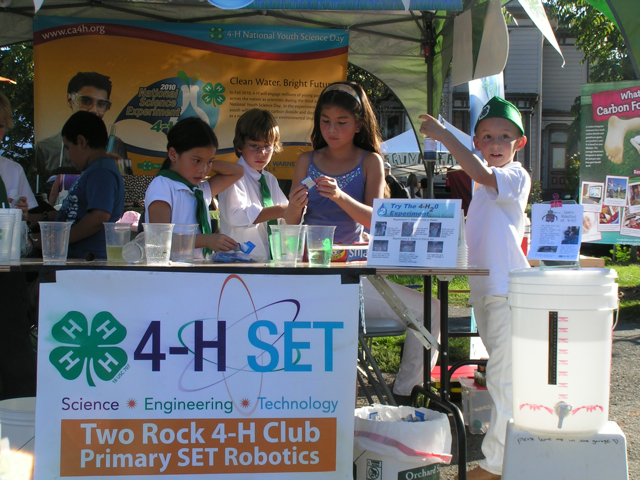
2010 4-H National Youth Science Day
Our CO2 Turtlebot worked great and kids had a great time trying to maximize their CO2 output by holding their breath then signing the results as drawn by the Lego NXT robot.
Special thanks to Brian Davis of the NXT Step for his support in helping us build and program our Lego robot. Using the power of the Internet for collaboration, we conserved resources in this project. and many thanks to John Melville at Vernier Software & Technology who provided us guidance on how to connect their CO2 sensor to our robot.
We had many kids try the 4-H2O experiment and kids really got the concept of the effects of CO2 in water and the air. Some kids found that increasing the amount of CO2 in the plastic bags led to "explosive results", much to the amazement of onlookers.
We also had a chance to test some of our solar model cars as part of our 2010-11 4-H project activities. Some cars worked better than others, with the overall winner being the easy to build "Solar Grasshopper". This was the first time Two Rock 4-H had done a science event like this and I am very pleased for all the support and encouragement we had from our club and the community.
Friday, September 24, 2010
4-H Foundation BBQ Fundraiser a Success
Friday, September 17, 2010
Demo of the CO2 Turtlebot
The Two Rock 4-H club will be showing its Turtlebot and many other technology projects on October 2, 1-5 PM during the National Youth Science Day in Walnut Park, Petaluma CA.
Tuesday, August 10, 2010
2010 4-H National Youth Science Day
In 2009, the Two Rock 4-H Club started a SET project titled "Robots in the Environment". We looked at how robots interact and sense their surroundings and we made several different robots, including working underwater remotely operated vehicles.
For the 4-H NYSD event, we will have a 10' x 10' booth and have four activities related to this years theme - "Clean water, bright future"
1. The NYSD Experiment - Two Rock 4-H volunteers will lead the public through the bromothymol blue, pH experiment. We ordered 75 4-H experiment kits and will have on hand additional experiment materials as a reserve.
2. CO2 "Turtlebot" - We have a Lego's Mindstorms NXT "robot turtle" which senses CO2 levels and draws the results on a long piece of paper. the public can blow into a straw tubing and the turtlebot will measure the CO2 in their breath, then draw the results as a line on a piece of paper. Participants can sign their name on their line, at the end of the day we will have a long sheet of paper made up of hundreds of lines, each symbolic of the carbon footprint humans have on the planet.
3. "Weigh your carbon footprint" - We will have a wooden balance scale and various weights, each weight representing "tons of carbon" per capita. Participants will stack weights based on their unique carbon footprint (i.e. do they have a car, own a home, eat meat, take the car to school, etc). Next, participants will add weitghts tot he other side, each weight representing the average carbon footprint per capita from other countries. The message is that in the US, our consumption produces much more carbon than that of other countries.
4. "Eco-Robots" - 4-H kids will show off some simple robot kits that run off solar energy or wind power. Our 4-H project theme for 2010-11 is "Kid Powered Creations" and we will be building several creations that use alternative energy power (i.e. solar, wind, pneumatic, water). On October 2, we will preview some of these kits.
With help from Nxtasy.org, a Lego Mindstorms user community and Vernier Instruments, makers of environmental sensors that connect to Lego NXT, we have developed a CO2 sensing robot turtle that will measure the CO2 in your breath and draw the results on paper. 
Kids will also be able to "weigh" their estimated carbon footprint and compare their results with other nations and find ways they can help reduce their carbon footprint by recycling and reusing. This is a free event to all. For more information, please contact David Bell.
Map To Walnut Park
View Larger Map
Thursday, July 1, 2010
First Test Sea Perch ROV
Next test, we'll use a color video camera and add an underwater hydrophone to record sthe sounds of the sea. It will be exciting with our 4-H group gets back together and we can take these ROV's to Bodega Bay and beyond.
Monday, May 17, 2010
ROV's In Action - Responding to the Gulf Oil Spill
Update: BP Provides Live Video from underwater pipe leak.
Monday, May 3, 2010
"ROV In A Box" A Big Hit at 4-H Chicken-que

The Two Rock 4-H Club Primary SET Robotics group participated in the annual 4-H Chicken-que in Santa Rosa, CA. The ROV-in-a-Box Project Kit, created by Nventivity, was a big hit as the 4-H kids were enthusiastic to explain how ROV's work and show off their own ROV projects. We were able to showcase all our recent activites, including the Hexbugs, Tamiya Mechanical Walkers, Scribbler Robot (that was misbehaving) and ROV's. The merits of 4-H were prevalent as the the kids did all the interaction with the public and were enthusiastic to share their knowledge of robotics.
Wednesday, March 24, 2010
New Grant for Two Rock 4-H SET Project
Judy Ludovise, Sonoma County 4-H YDP Representative informed me that the Two Rock 4-H Primary SET project has received $1,400.00 in State funding for use on our robotics projects and a 4-H Primary Science Field Day to be held in October 2010.This is great news, as it means that we'll be able to do more robotics projects as a group, and show other 4-H clubs what we have accomplished.
Monday, March 15, 2010
Meeting #4
The kids had a great time looking at the minimal instructions that were provided and building the ROV as shown in the photos. We learned about buoyancy and the importance of properly weighting an underwater craft so it can efficiently move. We also learned about propulsion, and the need to mount motors correctly so the craft moves in a predictable way.
Monday, February 22, 2010
Meeting #3

Our third meeting for the Two Rock 4-H Club Primary SET project was a lot of fun. This meeting was all about circuits, and what a circuit is and how to make one. We started off by looking at a simple circuit with a battery, wire and a light. Then we opened up our circuit kits which each of us made a circuit game. It was great fun watching the kids experience how to "test a nine volt battery" with their tongue! OK, let's not do this at home though.
The circuit kits were a great introduction to basic robot wiring and circuitry, and the kids were then ready to tackle more complicated tasks by experimenting with the Snap Circuits kit and rover. Thanks to all the parents who helped out and assisted kids in building their projects. We could not have a great SET project without all their help.
Friday, January 15, 2010
Meeting #2
We had another great meeting yesterday for the Two Rock 4-H Club Primary SET Robotics Project. Our meeting was all about motion – how robots move and how we use things like motors, gears, axels and linkages to make motion in mechanical things. To illustrate this concept for our kids, we all got Tamiya Robocraft Series robot animals (dogs, pigs, tigers, rabbits and kangaroos).
The mechanical walkers are great little robot kits that have many, many, small parts but are all similar in construction. Kudos to the brave parents that opted to build their kits from scratch – this was a big feat to start on the end of a Sunday but we all finished.
Sunday, December 20, 2009
Meeting #1
On Sunday Dec 20, we had a great first meeting with the Two Rock 4-H Club Primary SET members. We started off the meeting by talking about what robots are, what they do and some of the activities we will do in our project such as building our own “bug bots” and underwater “Sea Perch” ROV’s.
Next, we were unwrapping our Hexbugs and seeing what these little robots can do, how they bump into each other and how the kids could trap them in various mazes. We finished the meeting by building our very own “bug bots”, all from scrap pieces of old pager parts, wire and a pill box. The battle between the “Bug Bots” and the Hexbugs moved to the floor and we finished the day. Pictures and videos of our meeting are below.
Tuesday, December 8, 2009
What Is BEAM?

BEAM is a design philosophy that emphasizes simple design solutions to building robots. The most common BEAM acronym stands for:
Biology | Electronics | Aesthetics | Mechanics
Biology
BEAM robots use nature as a guide in the design of your robotic creature. Why re-invent the wheel when nature has already done so?
Electronics
These are the guts of what run a robot. The difference here is that most BEAM robots do not use a programmed microcontroller. For some applications simple components like a reed switch can do the job quicker and easier than a microcontroller.
Aesthetics
Form follows function, there is a reason falcons are shaped the way they are, there is a reason pigs don’t fly. Although not always the case the general rule is that the better constructed the robot the better it will perform. The aesthetics can also be seen as the artistic side to building robots. If your going to do it it may as well look good.
Mechanics
No matter how good the control electronics are they can not make up for bad hardware, as it’s exceedingly difficult to walk on broken legs. This is key in determining the lifetime and performance of your robot. Don’t underestimate the value of good mechanisms.
More information on building the “Coat Hangar Walker” you see above can be found here.